

Categories
Home Buyers, Houston TexasPublished November 11, 2026
Houston MUD Taxes: What Buyers Should Check Before an Offer

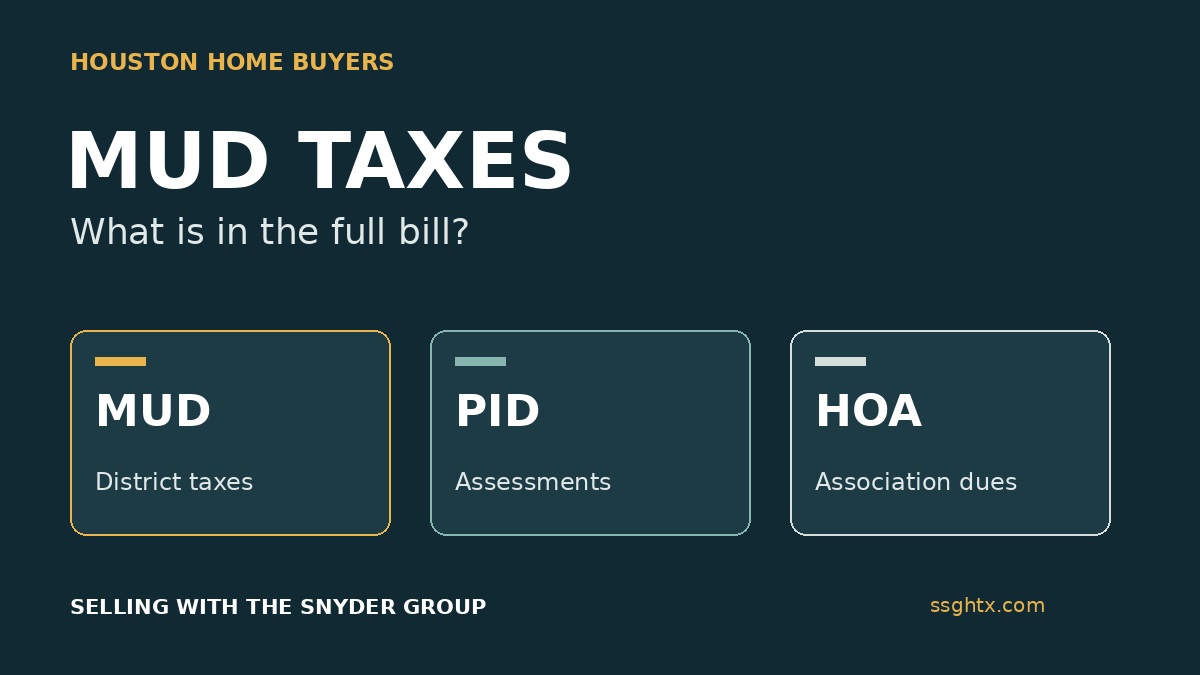
A MUD tax is a property tax levied by a Municipal Utility District. For a Houston-area buyer, the useful question is not just "Does this home have a MUD?" It is "What is the full annual cost for this exact property, and is every charge already included in our payment estimate?"
We would compare two homes using the same budget worksheet: mortgage principal and interest, all property taxes, insurance, HOA dues and any separate assessments or utility charges. A lower purchase price does not settle that comparison.
What does a MUD pay for?
A Municipal Utility District is a public district that can finance and provide infrastructure and services such as water, wastewater and drainage. Depending on its authority, it may also provide other facilities or services. District taxes can support debt repayment and ongoing operations. The district's own records tell you what applies.
For a local example of the records available, Harris County MUD 365's documents page publishes tax-rate history, tax orders, exemption resolutions and a notice to purchasers. That is the kind of source we want for the district serving a home. It is not a reason to apply that district's rate to another address.
MUD, PID and HOA: keep the questions separate
- MUD: Ask for the district name, current adopted property-tax rate, required purchaser notice, debt information and any other applicable fees or assessments.
- PID: A Public Improvement District can involve an assessment for authorized improvements or services. Ask the responsible city or county for the exact parcel's assessment, current annual installment, service-plan update and any payoff information.
- HOA: Review association dues, what they cover and any separate charges in the association documents. Do not treat HOA dues as a substitute for district taxes or assessments.
TREC's special taxing or assessment district notice, Form 59-0, explicitly says it is not for PIDs. The separate PID assessment addendum explains that annual installments may vary with interest, collection, administration and delinquency costs. "Annual" does not mean "fixed forever."
How much can the tax difference change a monthly budget?
Here is an illustration, not a quote for a Houston neighborhood. Suppose two homes each have a taxable value of $400,000 for every taxing unit in this simplified example. One has a combined rate of $2.20 per $100 of taxable value; the other has $2.70.
- At $2.20 per $100: $400,000 ÷ 100 × $2.20 = $8,800 a year.
- At $2.70 per $100: $400,000 ÷ 100 × $2.70 = $10,800 a year.
- The difference is $2,000 a year, or about $167 a month, before insurance, HOA dues or other costs.
In a real estimate, calculate each taxing unit separately because exemptions and taxable values may differ. Then add those amounts. Also check whether the quoted combined rate already includes the MUD. Adding it again would overstate the bill.
Our address-by-address checklist before an offer
- Identify the parcel. Match the street address and account number to the county appraisal record and latest tax statement. Do not use a neighborhood name as the final answer.
- List every taxing unit. Ask for the current adopted rates and any district assessments. Separate actual adopted rates from proposed or projected rates.
- Get the district's purchaser notice. TREC says sellers should use the district's own notice when available. If it is not published, the information should come from the district. Review this with your agent before the contract is executed, not as a last-minute closing surprise.
- Confirm the source. TCEQ's Water District Data page can help locate district names, contacts and service-area information. TCEQ notes that records can be missing or out of date, so confirm the property with the district and title company.
- Ask about exemptions and value. Request a lender estimate for your ownership situation, not an assumption that the seller's exemptions transfer unchanged. Confirm your eligibility with the appraisal district.
- Reconcile the payment. Have the lender explain which taxes and insurance are included in the estimated monthly payment. Track HOA dues, PID installments and other charges wherever they are actually payable.
For new construction, ask whether the value used in the estimate reflects the completed home or only land and partial construction. The Texas Comptroller explains that property is appraised as of January 1. An old tax statement and a completed-home budget may answer different questions.
Will the MUD rate fall as the community grows?
We would not buy based on a promised future reduction. TREC's notice warns that district information can change and that tax rates are established annually. A growing tax base or older infrastructure does not give us a guaranteed future bill. Ask for current documents and budget from what can be supported today.
Likewise, a homestead exemption is not one identical discount across every line of the tax bill. The Texas Comptroller's exemption guidance distinguishes required exemptions from local-option exemptions. Check each taxing unit and your own eligibility rather than subtracting the same amount everywhere.
Compare the home, not the acronym
We would not rule a home in or out because the listing says MUD. We would ask whether its total cost fits, what services the district provides and whether the paperwork supports the estimate. For the wider budget, our Houston cost-of-living guide covers expenses beyond taxes, and our Houston closing-cost guide explains the separate cash-to-close question.
Frequently asked questions
Is a MUD tax already included in the listed property-tax rate?
It may be included if the listing shows a combined rate, but do not assume it is. Match the exact property to its taxing units and ask the lender whether the payment estimate includes every applicable district tax. Do not add the same MUD tax twice.
Does a MUD tax replace the water bill or HOA dues?
Do not assume that it does. Review the district tax, current utility charges and HOA documents separately. They fund different obligations, and the amounts depend on the property and governing documents.
Will the MUD tax go away when the neighborhood is finished?
There is no automatic end date you should use in a home-buying budget. Districts establish tax rates annually, and taxes may support operations as well as debt. Ask the district about current obligations and proposed changes.
Is a PID the same as a MUD?
No. A Public Improvement District assessment is a separate inquiry with its own notice and assessment information. TREC Form 59-0 explicitly says it is not for PIDs; TREC has a separate PID assessment addendum.
Does the seller's tax bill tell us what we will pay?
It is a starting point, not a personal quote. Taxable value, exemptions and future adopted rates can differ. Ask for an address-specific estimate using the exemptions for which you expect to qualify, then confirm eligibility with the appraisal district.
This is general home-buying information, checked November 11, 2026, not legal or tax advice. Your district, appraisal district, lender and title company should confirm the figures and requirements for your transaction.
Sources
- Texas Real Estate Commission: district purchaser notice guidance and the linked TREC forms above.
- Texas Real Estate Research Center: MUD notice requirements, July 29, 2024.
- Texas Comptroller: property-tax system basics and exemption guidance linked above.
- TCEQ district data and Harris County MUD 365 documents linked above.
Featured image: original SSG buyer-budget illustration; not a photograph of a property or district.
Thinking about buying or selling around Houston? Call or text us at (346) 452-2290.

Selling With The Snyder Group
| Selling with The Snyder Group | eXp Realty | PLACE
or another way